Easy Dog Training Tricks: 15 Fun Skills to Teach at Home
Trick training is not frivolous. It improves communication, gives dogs mental work, lets owners practice timing without the pressure of a behavior problem, and can build body awareness that supports everyday handling and sport. The best beginner tricks are easy to break into small steps and safe for the dog’s age and body.
Use tiny rewards, train on non-slip flooring, keep sessions short, and stop before frustration. Avoid repeated jumping, tight spinning, or difficult balance work in growing puppies, arthritic dogs, or dogs with orthopedic limitations. Modify the trick rather than forcing a body into a position that is uncomfortable.
1. Hand Target (“Touch”)
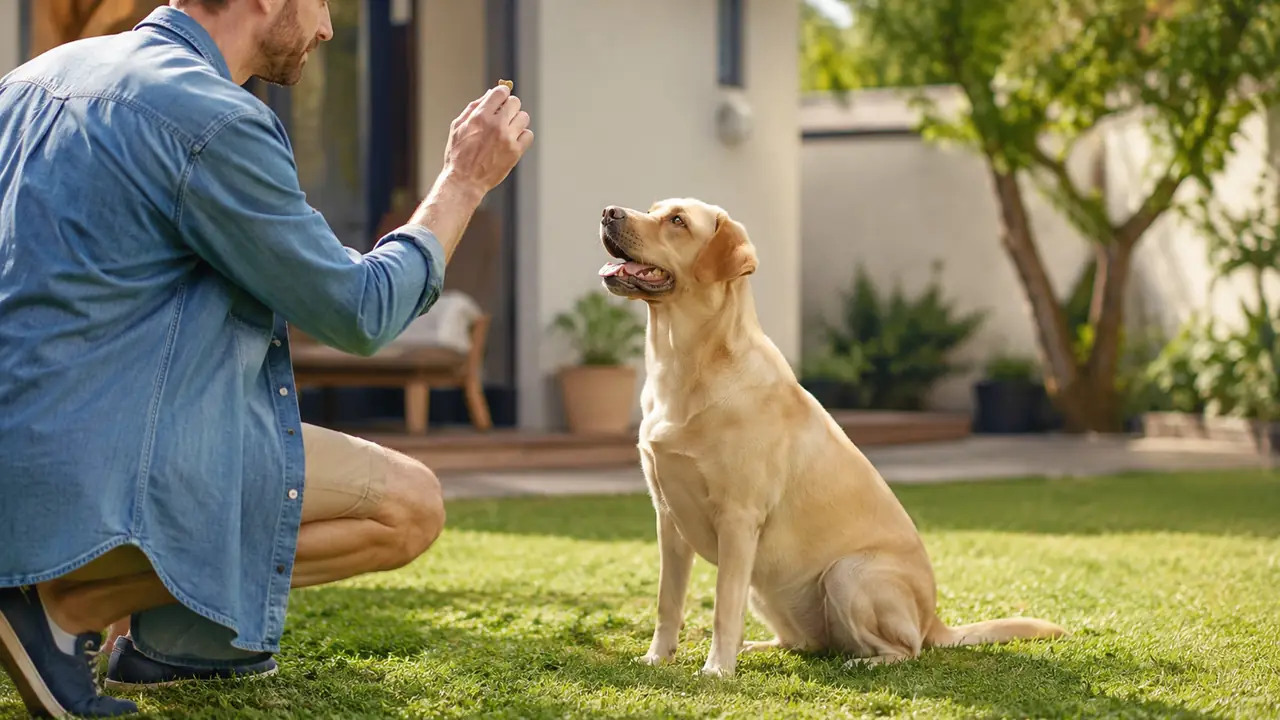
Present an open palm near the dog’s nose. Most dogs investigate; mark the nose contact and reward. Gradually move the hand to different positions. Touch becomes useful for recall, positioning, cooperative care, and redirecting attention.
Start close: offer a relaxed open hand just beside the muzzle, rather than reaching toward the dog. A curious nose movement is enough for the first success. Say your marker word at contact, then deliver a treat with the other hand so the palm itself stays a clear, predictable target.
If the dog merely looks at your hand, reward the glance and try again. After several voluntary contacts, shift your palm a little to the left, right, or lower down. Avoid chasing the dog's nose; the useful lesson is that choosing to approach the target earns the reward.
Once touch is easy in a quiet room, use it as a gentle way to position your dog before putting on a harness or moving away from a doorway. A target is an invitation, not a means of forcing the head into uncomfortable handling; let the dog step away and reset.
Introduce the spoken cue just before offering the familiar palm, and practise in a second room before adding distractions. If touches become hesitant or the dog mouths the hand, simplify the setup. Dogs Trust describes progressive, reward-based target training as a voluntary foundation for handling and positioning. Dogs Trust: target training.
2. Spin
Lure the nose in a wide circle, mark when the dog completes the turn, and reward. Fade the lure into a hand signal. Teach both directions and keep circles wide for dogs with mobility concerns.
Place a small reward near the dog's nose and guide it in an unhurried arc wide enough for a comfortable turn. Mark a quarter-turn initially if a full circle is confusing. Deliver the reward low and slightly forward so the dog is not repeatedly twisting its neck upward to follow food.
Once a complete circle is smooth, repeat the same hand motion without food in that hand and pay from the opposite pocket. Gradually shrink the gesture. Add 'spin' only when the movement is predictable; naming it earlier often leaves the dog guessing which part of your motion matters.
Teach clockwise and counterclockwise as separate easy tasks. Several repetitions in one direction can create unnecessary strain, especially for dogs with stiff backs, sore knees, or unstable footing. A slow half-turn on a grippy floor is more valuable than a fast, slippery performance.
If your dog sits midway or wanders off, reduce the arc and reward a smaller effort. Do not physically turn the body with the collar. The Dogs Trust guide to teaching a figure of eight uses the same progression of comfortable luring, removing the food lure, and fading the hand signal. Dogs Trust: marker circling.
3. Paw/Shake
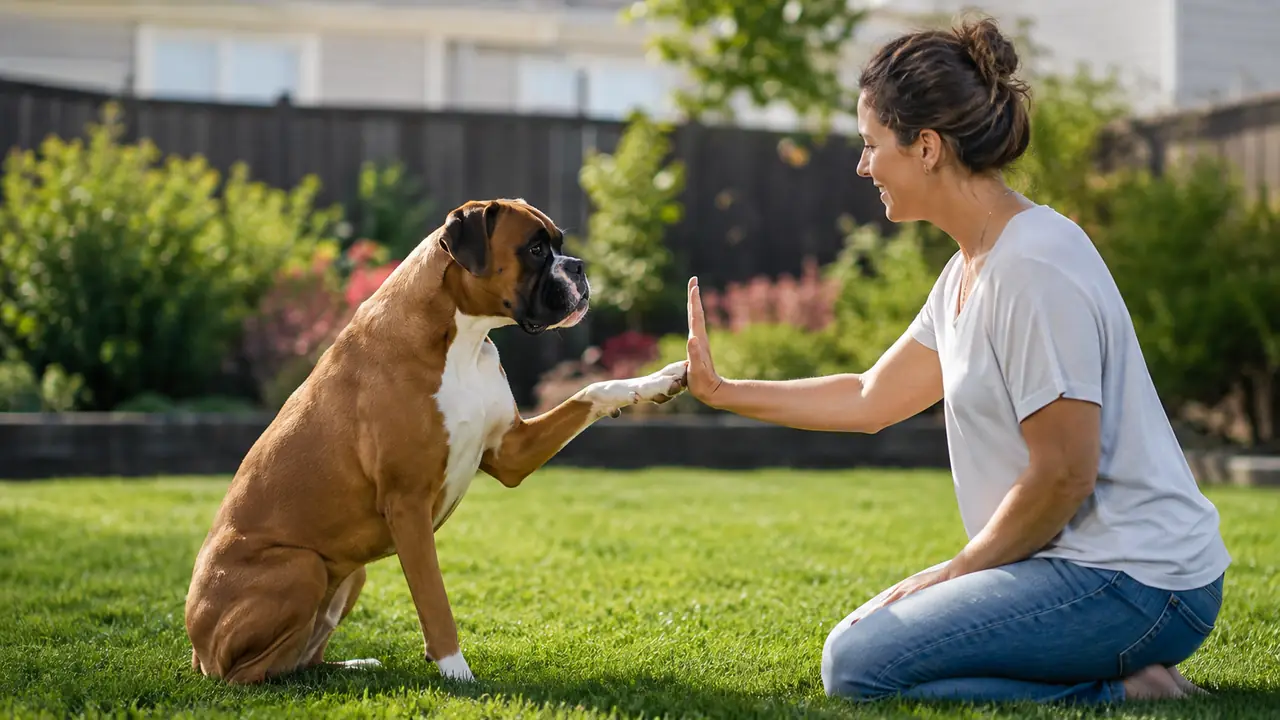
Capture a natural paw lift or gently wait with a closed hand until the dog offers a paw; mark and reward. Avoid repeatedly grabbing the paw if the dog dislikes handling.
Watch for a paw that lifts naturally while the dog is seated or shifting weight. Mark that voluntary movement, even if the paw rises only slightly. You are reinforcing a choice, not teaching that a human may repeatedly pick up and manipulate a limb without warning.
Some dogs offer a paw when a closed hand holding a treat is presented at chest level. Reward the lift, then show the same closed hand without food and deliver the reward separately. If the dog paws hard or scratches, reinforce gentler movements and keep your hand farther back.
Move from a tiny lift to a brief tap against your open palm, stopping before the dog becomes unbalanced. A short shake can help develop a future consent-based grooming routine, but it does not mean your dog automatically accepts nail trimming or painful paw examination.
A senior dog with arthritis may prefer to learn a nose target instead, and a dog guarding an injured limb should not be asked for 'paw.' Dogs Trust teaches high-five and paw by marking voluntary paw contact and gradually adjusting the hand target, not by forcing the leg. Dogs Trust: paw training.
4. Chin Rest
Hold a flat hand under the dog’s chin and reward any voluntary contact. Gradually build duration. A chin rest can become a cooperative-care position for eye, ear, or grooming work.
Begin with a palm or folded towel at a height where the dog can rest its chin without stretching. Reward a momentary touch, then remove the target. The first goal is a willing chin placement, not duration; a shy dog may need reinforcement simply for bringing its head toward the support.
Build duration in tiny steps: chin down, mark; chin down for an extra breath, mark. Release with a consistent word and give the dog room to lift its head. The option to leave is what makes this trick useful during cooperative grooming rather than an improvised restraint method.
When the position is comfortable, briefly bring a brush into view without brushing, reward, and end the session. On another day, touch a shoulder lightly while the chin rests. Introduce one new element at a time so the dog can distinguish voluntary participation from being held still.
Do not practise with an infected ear, sore jaw, or a dog already fearful of handling until a veterinarian and qualified reward-based professional have addressed those needs. Target training guidance from Dogs Trust supports helping dogs choose positions before grooming and veterinary care. Dogs Trust: voluntary targeting.
5. Go to Mat
Reward stepping onto a mat, then four paws, then lying down. Add duration gradually. This “trick” is one of the most useful household skills for meals, visitors, and calm evenings.
Choose a mat that stays flat and is large enough for your dog to turn around and lie on comfortably. At first, toss a treat onto it for one paw, then reward when both front feet, and eventually all four feet, arrive. Let the dog step away between repetitions.
Once the dog enters readily, wait for a sit or relaxed down and reward that choice on the mat. Feed calmly between the front paws rather than creating frantic bouncing. Add a release cue so 'on your mat' never becomes a demand to remain there indefinitely.
Next, carry the mat to a second quiet location while keeping your criteria easy. A dog who can settle in the living room has not necessarily learned to relax beside a noisy family meal. Build duration before introducing visitors, movement, or tempting food on nearby surfaces.
Use the mat as a safe resting station, never a place for punishment or isolation. If your dog pants, scans the room, or repeatedly leaves, ask less and check whether the space is comfortable. Dogs Trust provides specific settle-on-a-mat advice for helping dogs relax. Dogs Trust: settling on a mat.
6. Find It
Toss one treat nearby and say “find it.” Progress to easy hidden food or toys. Scent work is naturally reinforcing and provides low-impact mental exercise.
Begin indoors with one visible treat on a clean floor. Say 'find it' as your dog lowers its nose, then let the dog discover the reward without repeated instructions. Once the game is understood, place a treat partly behind a safe furniture leg or under the edge of a washable towel.
Increase search difficulty by changing only one feature at a time: a slightly wider area, a new hiding spot, or a slower start. A beginner can struggle if you scatter many tiny pieces in tall grass before the cue has any meaning. Keep early searches short and successful.
Outside, select a pesticide-free patch free of litter and unfamiliar food. Scatter only pieces of your dog's usual approved treats and supervise closely; scent games should not turn into scavenging discarded bones, mushrooms, or rubbish. Pick up anything that could be swallowed unsafely.
For dogs recovering from injury, gentle sniffing games may offer enrichment without jumping, provided their veterinarian permits the activity. Stop if the dog becomes frantic or resource guards the search area. Dogs Trust recommends safe enrichment and sniffing opportunities as part of daily welfare. Dogs Trust: safe enrichment.
7. Middle
Lure the dog to stand between your legs facing forward. Reward in position. This can become a fun photo trick and a secure station in crowded spaces for dogs who enjoy it.
With your feet comfortably apart, invite the dog into the space from in front with a small food lure. Reward just one step into the gap, then toss a treat forward as a release. This teaches that 'middle' has a clear exit rather than trapping a dog between moving legs.
Slowly build to standing with the body aligned in the same direction as yours. Keep your own knees soft and stable. Do not attempt this on stairs, near traffic, or while walking through a dense crowd; a photo-worthy posture is not a safe substitute for a properly controlled lead.
Some dogs dislike a narrow space around their shoulders. Watch for freezing, lowered posture, or repeated avoidance. Give them a choice: reward a step toward the gap or teach 'stand beside me' instead. Never pull the dog by its collar between your legs.
For a taller dog, adjust your stance rather than expecting uncomfortable crouching. A verbal cue is useful only after the dog chooses the position reliably. Reward-based training guidance from AVSAB favours voluntary learning and avoiding physical or psychological pressure. AVSAB: humane training.
8. Bow
Capture the stretch when the dog lowers front legs while keeping the rear up, or lure carefully from standing. Mark early before the dog lies down. Avoid pushing the dog into position.
Observe your dog after waking or during a relaxed play session: many dogs naturally stretch with their chest lower and hips raised. Mark the instant that shape appears, then reward. Capturing an offered bow usually produces a more comfortable movement than trying to hold the rear up by hand.
If you lure from standing, move the treat slowly down toward the floor and slightly backward, rewarding the first lowered elbows before the dog lies down. Reset in a standing position for the next attempt. The reward should follow the effort immediately, not arrive after a long struggle.
Place a nonslip mat beneath the front feet and keep sessions brief. Avoid bows for dogs with shoulder, elbow, back, or knee pain unless cleared by their veterinarian. Puppies, older dogs, and individuals with unusual conformation may find the position harder than it appears.
Distinguish a trained bow from a spontaneous play signal: a dog may offer the latter to communicate during social play. Neither should be elicited with physical pressure. The AVSAB humane training position supports shaping with rewards rather than aversive handling. AVSAB: humane training.
9. Back Up
Stand in a narrow hallway or use body position without crowding, reward one backward step, then build distance. Backing improves body awareness and can help positioning.
Stand facing your dog on nonslip flooring with an empty, clear space behind it. Take a very small step forward without leaning over the dog's face. Mark and reward the first voluntary backward paw movement; one step is a complete success at this stage.
If the dog instead sits, return to a neutral posture and try again with less forward motion. A narrow but open-ended corridor can help a beginner understand the direction, yet it must never become a trap. Move slowly enough that the dog has time to think.
Once a single backward step is easy, reward two steps, then three, keeping the distance modest. Choose a cue such as 'back' only after the behaviour is predictable. Practise beside a wall before asking for a straight line in an open room, where drifting sideways is normal.
Do not back a dog toward furniture edges, stairs, other pets, or a person with limited mobility. If a dog hesitates because of hip or spinal pain, skip the trick and arrange veterinary advice. Dogs Trust's positive reinforcement principles favour breaking skills into achievable rewarded steps. Dogs Trust: rewards.
10. Around a Cone
Place a cone or safe object and lure the dog around it. Fade the lure and send from increasing distance. This becomes foundation work for agility-style handling.
Place a stable cone, bucket, or smooth upright marker on the floor with space on every side. Lure your dog around a generous circle and reward just beyond the object. The goal is a curved path around a visible landmark, not a fast pivot that twists the body tightly.
At first stand close to the marker and guide the full movement. Next, send from a short distance with an empty hand gesture, paying immediately after the dog emerges on the other side. Reward consistent direction before trying to increase speed or practise a more complex course.
If your dog cuts between you and the cone, move closer and exaggerate the hand path for one repetition. Work both directions as separate cues. Choose a marker that will not topple loudly and frighten the dog, especially if the learner is sound-sensitive.
For an active dog this can form the basis of controlled obstacle work, but jumping and sharp turns belong in an individual fitness plan. Dogs Trust's figure-of-eight instructions describe gradually luring around markers and fading prompts once the path is comfortable. Dogs Trust: object circling.
11. Tidy Up Toys
Teach hold or pick-up, then reward dropping a toy over a box. Shape closer drops until the toy consistently lands inside. Start with one easy toy.
Start with an easily gripped soft toy, not a heavy object or a favourite item the dog guards. Teach 'take' and a relaxed 'drop' as separate behaviours. A reliable voluntary release is the foundation of putting the toy into a basket rather than running away with it.
Put a broad shallow basket close to the dog's mouth. Reward dropping the toy near the rim, then just over it, then inside. Keep the basket stable and avoid presenting it so high that the dog must strain the neck or rear up to reach the opening.
Once a toy lands in the box consistently, move the toy half a step away, ask for pick-up, and cue the familiar drop above the basket. Build the chain with one object before introducing others; different shapes and textures can change how readily a dog chooses to carry them.
Never chase a reluctant dog or prise the toy from its mouth. If growling or stiff guarding appears, end the game and consult a qualified force-free professional. Dogs Trust teaches the pick-up, carrying, basket target, and drop stages as separate parts of tidying up. Dogs Trust: toy retrieval.
12. Peekaboo
Lure the dog from behind you to place its head between your legs. Reward briefly and release. Ensure the dog is comfortable with the body position and never trap it.
Stand with your feet apart at a distance that gives the dog a clear route. From behind, invite the dog forward with a food reward held where the nose can follow safely. Reward the first voluntary peek through the gap rather than keeping the head wedged between your legs.
Teach a release word immediately, then throw a small reward ahead to make exiting easy. Once the dog understands the sequence, lengthen the pause by a second before release. Keep both feet planted; stepping abruptly could startle or accidentally strike the animal.
Peekaboo differs from the 'middle' position because it may begin behind the handler and finish with only the head emerging. Help the dog understand which direction earns the reward. Alternate easy repetitions rather than turning it into a prolonged balancing exercise.
Skip this skill if either person or dog has balance limitations, severe handling fears, or painful joints. If the dog backs away, offer a side target instead. AVSAB's humane training statement supports teaching optional, enjoyable behaviours without force. AVSAB: voluntary training.
13. Wave
Start from a paw/shake behavior, move your hand slightly away so the dog lifts the paw without contact, mark, and gradually shape a higher wave.
First establish a comfortable paw lift on a hand signal. Then present your hand slightly beyond where the paw would ordinarily make contact. Mark and reward as soon as the paw rises into the air, even if the dog does not reach the hand at all.
A wave is a small lifted forepaw, not a request for repeated high reaching. Ask for one controlled lift, reward, and let the dog settle its weight. Moving the hand too high may cause hopping or twisting, so keep the motion within your dog's natural range.
When the air-lift happens regularly, add 'wave' just before the familiar signal. Fade the signal toward a small greeting gesture. Practise with a friend standing quietly at a distance before expecting the dog to wave while several people move and talk around them.
Dogs with shoulder pain, balance difficulties, or sore wrists may prefer to greet through a nose touch. Never pull the paw to demonstrate the movement. Dogs Trust's paw and high-five lesson provides a voluntary, reward-based progression on which a wave can be built. Dogs Trust: paw/high-five.
14. Put Paws on a Platform
Reward front paws on a low stable non-slip platform. This builds body awareness and can help positioning for photographs or husbandry. Keep the platform low and stable.
Select a wide, low, nonslip platform with no sharp edges and no chance of tipping. Reward the dog for looking at it, then for one front foot touching it, and finally for placing both front paws on the surface. Keep the platform far below the height of a jump.
Mark the moment both paws settle, pay in a position that keeps the dog's weight comfortable, and invite a slow step off. Build a brief still pose only when the dog seems relaxed. A small wobble means the equipment needs fixing, not that the dog needs more repetitions.
Try a different safe platform after the first one becomes familiar. Novel surfaces are a distinct challenge, so return to rewarding one foot. For large dogs, check there is room for each paw without crowding or toe overhang before adding a photo cue.
This exercise is not appropriate for an animal with joint pain or loss of balance unless the veterinarian approves. Never use unstable stools or stacked objects. Dogs Trust's 'paws up' trick explicitly stresses choosing sturdy, nonslip equipment before training. Dogs Trust: stable platforms.
15. Close a Drawer With a Nose Target
Place a removable target on a light safe drawer or cabinet. Teach nose touch to the target, then reward enough pressure to move the door. Never use heavy or pinch-risk furniture.
Start with an empty, lightweight drawer that can move a short distance with a soft push; remove anything sharp or valuable. Place a removable target on its front and teach the dog to touch the target while the drawer is held stationary, rewarding gentle contact only.
Next, leave the drawer almost closed so a light nose push moves it by a small amount. Mark that movement and reward. The dog should learn that a controlled tap is sufficient; never require a slam or use furniture with a spring action that snaps shut.
Check the clearance before every attempt. Keep fingers, whiskers, and paws away from pinch points and put other pets outside the practice area. If the drawer shifts unpredictably or makes a sudden loud sound, return to practising a stationary target on a flat board.
A touch target can become a practical household skill, but the furniture must be appropriate and supervision continuous. For dogs who are easily startled, the hand-target version is safer. Dogs Trust explains how a nose target can guide voluntary interactions with objects. Dogs Trust: nose targeting.
Common Mistakes to Avoid
- Training on slippery flooring
- Making food lures permanent
- Repeating a trick after the dog is tired
- Using high-impact tricks for young puppies
- Physically pushing the dog into positions
- Training only the dog’s stronger turning direction
- Raising difficulty before the dog understands the basic action
A trick can look simple yet be uncomfortable when practiced on slick flooring, through repeated twisting, or when the dog is still growing or has joint pain. Avoid pushing paws into place or pulling the dog through a movement. Instead, use a stable surface and a reward-based lure or small approximation that the dog can choose to perform. Gradually fade the visible food lure so the cue, rather than the hand holding food, predicts the behavior. End the session at the first signs of fatigue or avoidance, and modify or skip spins, bows, jumps, or other physically demanding moves if veterinary advice or the dog's comfort calls for it.
A Practical Decision Checklist
- Surface non-slip
- Rewards tiny
- Session short
- Movement comfortable
- Lure faded gradually
- Both sides trained when relevant
- Dog can opt out
- Trick modified for age and health
Select one low-impact trick that matches the dog's mobility today; check the floor for grip and use tiny rewards that fit the daily food allowance. Plan two or three small learning steps rather than expecting the finished movement immediately, and note which cue will eventually replace the food lure. For turning tricks, train each direction only if both are comfortable. Keep practice optional and brief, with a familiar easy behavior available as a break. Progress is shown by relaxed, repeatable responses without physical prompting, not by how many tricks can be forced into one session.
Frequently Asked Questions
How many tricks should I teach at once? Two or three in short separate sessions is fine, but avoid drilling so many new cues that the dog becomes confused.
Can puppies learn tricks? Yes, especially low-impact skills such as touch, mat, find it, chin rest, and simple positions. Avoid repetitive jumping or demanding balance work.
What if my dog lies down instead of bowing? Mark earlier while the elbows are lowering and rear is still up, or capture a natural morning stretch.
How do I fade food lures? After several successful repetitions, make the same hand motion without food in the hand, then reward from the other hand.
Are spins bad for dogs? A few controlled wide spins are fine for many healthy dogs, but repeated tight rotations are not appropriate for every dog. Modify for orthopedic or neurologic issues.
Can tricks improve confidence? Yes when the dog has choice, understands how to earn rewards, and the difficulty stays below frustration.
Which trick is most useful? Hand target, mat work, chin rest, and find it transfer especially well to everyday life.
The Bottom Line
Trick training should feel like a game the dog understands. Build one small piece at a time, use safe footing, reward generously, fade lures, and choose movements that fit the dog’s body. The result is not just a list of party tricks but better communication and a dog that enjoys learning with you.